Access Is the Mission
Start with the moral center of Pichai’s work: useful technology for everyone.
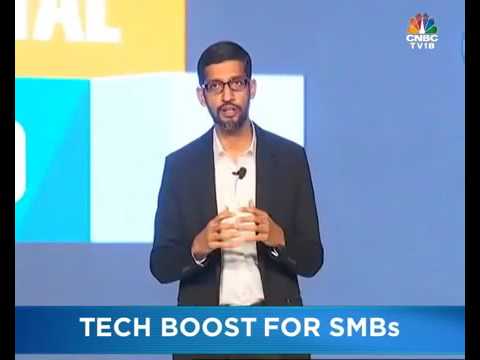
“Our mission for the last 18 years has been to organize the world's information and make it universally accessible.”Digital Unlocked event, 2017 · 10:08
The lesson
Pichai’s throughline starts with access. Across these talks, he returns to Google’s mission as making information universally accessible and useful, and he treats that not just as a product goal but as a moral one123. In this chapter, the key idea is that usefulness for everyone is the standard that connects his personal story, Google’s global product strategy, and his view of AI.
That mission becomes concrete in places where access is limited or uneven. In India, Pichai describes the internet as something that should serve both ambitious startups and established local merchants, not only the already advantaged4. He also argues that when Google builds for the needs of a place like India, the lessons often travel outward and improve products for people everywhere5.
This is why Pichai often talks about access in practical terms: discovery, language, speed, affordability, and support. He ties Google’s work to helping small businesses get found and grow, while also emphasizing that products should get people answers quickly and efficiently6. Access, in his framing, is not merely connectivity; it is whether technology is actually usable and helpful in real life.
AI extends that same mission rather than replacing it. Pichai presents AI as a way to expand knowledge, translation, learning, and accessibility, and he suggests that it can push Google’s mission further by acting more like a helpful collaborator78. But he pairs that optimism with a requirement for responsibility, arguing that powerful technology should be developed with care, safety, and governance in mind9.
A useful way to read Pichai is to see a consistent test underneath the technology changes. Whether the topic is Search, digital tools for merchants, or AI features, he asks whether the work genuinely helps people improve their knowledge, success, health, or happiness10. So the moral center of access is not abstract inclusion alone; it is building technology that more people can actually use to do better in their lives.
5 principles from Sundar Pichai
Start from universal usefulness
Define the mission in terms of who gets helped, not only what gets built. In practice, ask whether your product or project expands access to information or capability for more people, especially those who are usually left out.
“Our mission for the last 18 years has been to organize the world's information and make it universally accessible.”
Build for constrained users to serve everyone better
Designing for markets with harder constraints can reveal what truly matters: simplicity, affordability, language support, and practical value. Those lessons often improve the product globally, not just locally.
“When we solve for a place like India, we solve for everyone around the world.”
Treat access as real-world usefulness
Access is incomplete if people cannot quickly get value from the product. Apply this by focusing on whether users can discover, understand, and use the tool effectively in everyday situations.
“…search was always about trying to get you the answer as quickly as possible…”
Use AI to widen capability, not just add novelty
Pichai’s standard for AI is whether it helps people learn, translate, communicate, or overcome barriers. Before adding AI, test whether it improves knowledge, success, health, or happiness in a concrete way.
“I mean, we have, I mean the test I use is, is this, if by creating a feature with this, is it going to be helpful? I think about it four dimensions is going to help people improve their knowledge, success, health, or happiness. Okay, if it fits one of those four attributes, I think it's good to do. So that's, that's kind of how I think about it. And if I feel it's not doing any of that, you know, I would question as to why we are adding that.”
Pair ambition with responsibility
Powerful technology should be pursued with optimism, but not casually. If a system can affect many people, responsibility, safety, and governance must be part of the design from the start.
“…we have to be very responsible…”
In his own words
The quotes behind the lesson, word for word from the transcripts. Numbers match the lesson above.
“Our mission for the last 18 years has been to organize the world's information and make it universally accessible.”
“…to make information universally accessible and useful…”
“I think it's a moral imperative to do that.”
“The internet is as much for the established local merchant as it is for a high-flying starter.”
“When we solve for a place like India, we solve for everyone around the world.”
“…search was always about trying to get you the answer as quickly as possible…”
“AI is the ultimate expression of that…”
“…we have a chance to do a step even more…”
“…we have to be very responsible…”
“I mean, we have, I mean the test I use is, is this, if by creating a feature with this, is it going to be helpful? I think about it four dimensions is going to help people improve their knowledge, success, health, or happiness. Okay, if it fits one of those four attributes, I think it's good to do. So that's, that's kind of how I think about it. And if I feel it's not doing any of that, you know, I would question as to why we are adding that.”
Reflect
- Where in your work are you designing mainly for expert or privileged users, and how would the product change if you started with people facing tighter constraints?
- Take one feature, service, or project you are involved in and test it against Pichai’s four dimensions: does it improve knowledge, success, health, or happiness?
- If you added AI to something you build or use, what concrete barrier to access would it remove, and what new risks would you need to manage?
Check your understanding
Go deeper
 Sundar Pichai on AI and Leadership: Building Technology for Everyone2022 · 46 min · full transcript
 Sundar Pichai on Innovation And India: Thinking Big, Building the Future2014 · 73 min · full transcript
 Sundar Pichai on AI Vision: Google, Gemini, and the Future2025 · 45 min · full transcript
 Sundar Pichai on Artificial Intelligence Policy: responsibility, trust, and global rules2017 · 30 min · full transcript
 Sundar Pichai on Digital Transformation: Small Business Growth in India2017 · 63 min · full transcript
 Sundar Pichai on AI and Accessibility: Google I/O 20222022 · 20 min · full transcript