Steve Jobs on Hiring: Bet on People, Not Credentials

What Jobs talks about
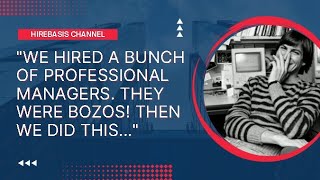
Jobs says Apple tried hiring “professional management” as it grew, but the results were poor. His point is blunt: good managers must understand how to do things, not just how to manage.
He argues that the best managers are often great individual contributors who never planned to manage, but step up because they have the ability to teach and build. He points to Apple’s willingness to give people like Debbie Coleman major responsibility despite limited traditional credentials.
The interview matters because it shows Jobs’s early belief in skills-based hiring and trusting talent over titles or rigid experience requirements. He frames Apple as a place where people were given unusual opportunities to prove themselves and help “write the book again.”
Jobs speaks throughout, with channel commentary added over the archival audio.
In his words
“Most of them were bozos.”
“They knew how to manage but they didn't know how to do anything.”
“If you're a great person, why do you want to work for somebody you can't learn anything from?”
“You know who the best managers are?”
“It didn't work at all.”
Key points
- Hiring “professional management” from outside did not work at Apple.
- Great managers are often top individual contributors, not career managers.
- People should want to learn from the person they work for.
- Apple gave major opportunities to people who lacked conventional experience but had strong ability.
- Jobs presents Apple as a place where people could prove themselves and reshape how things are done.
- The company bet on skill and potential over credentials alone.
Full transcript
Foreign, we went through that stage in Apple where we went out and we thought, "Oh, we're going to be a big company, let's hire professional management." We went out and hired a bunch of professional management. It didn't work at all. Most of them were bozos. They knew how to manage but they didn't know how to do anything. And so, if you're a great person, why do you want to work for somebody you can't learn anything from? Uh, and you know what's interesting? You know who the best managers are? They're the great individual contributors who never ever want to be a manager but decide they have to be a manager because, after hiring two professional managers
from outside the company and firing them both, Jobs gambled on Debbie Coleman, a member of the Macintosh team, 32 years old, an English literature major with an MBA from Stanford. Debbie was a financial manager with no experience in manufacturing. I mean, there's no way in the world anybody else would give me this chance to run the duration. Enough about that. This is an incredible high risk both for myself personally and professionally and for Apple as a company to put a person like myself in this job. I mean, they're really betting on a lot of things. We're betting that my skills at organizational effectiveness, you know, override all those, you know, lack of technology, lack of experience, lack of, you know, time and manufacturing.
So it's a big risk. And I'm just an example. And every single person on the Mac team, almost to your, you know, entry-level person, you could say that about. This is a place where people were afforded these incredibly unique opportunities to prove that they could do, they could, um, they could write the book again. Inscribed inside the casing of every Macintosh, unseen by the consumer, are the signatures of the whole team. This is Apple's way of affirming that their latest innovation is a product of the individuals who created it, not the corporation. Steve Jobs was simply way ahead of his time, decades ahead of his time. In a time when companies were looking more towards
degree requirements and exact experience requirements and rigidly applying them, he opened the door to skills-based hiring, which is amazing. He did this in 1981 with the Mac team, and look where this has gotten Apple today. Steve Jobs said, "Why hire professional management instead of selecting someone just based on their professional credentials? Focus on their skill set." And as you could see, Apple from the very beginning bet on people like Debbie Coleman and other similar people
who they evaluated their skill set rather than their credentials and technical experience and gave people a unique opportunity to shine. This is what skills-based hiring is all about. If it worked for Apple, the most successful business on planet Earth of all time, it can work for your company as well. If Steve Jobs were around today, I'm sure not only—as he's shown, he's a big proponent of skills-based hiring—he would be a big proponent of employer of record companies helping companies facilitate growth by allowing them to
hire internationally without having to worry about tax, you know, laws and payroll responsibilities and things like that, because all of these functionalities are taken care of by the employer of record company. You just pay them a monthly fee. And this is a new way to hire where you can hire people anywhere in the world. You just pay that monthly fee and you can hire anybody anywhere at tremendous savings because of the difference of cost of living in other countries. This is the future. This is where things are heading right now. And if you're a job seeker, get on Higher Basis, take our skills test, see where your skill level is, and also
present your profile with as much detail about your skill set you can. Definitely narrow down specific skills that you've also obtained and showcase what you're made of, basically what you're able to do. And employers who are seeking exactly what you're able to provide, they're gonna find you that way. And employers, HR, you're going to be able to find people anywhere in the world through Higher Basis. It's not just a job board, it's a candidate search board. So that's what's different about Higher Basis. So I urge you to go on Higher Basis and see for yourself. We're a work in progress. It's a functional product but we're continuously improving. We're seeking
perfection, which is not possible, but when you seek perfection, you should be able to reach excellence. With that said, thanks for watching and we'll see you in the next video. (music)
From YouTube captions, lightly punctuated for readability. Timestamps link to the video above. Errors are possible.