Technology and Adaptation
AI, innovation, and human adaptability in the next cycle.
“Yes. I study, you know, what was the impact of the printing press and what was the impact for the industrial revolutions and so on? This, in my opinion, is the biggest impact that we have because it will revolutionize all thinking that applies to everything and applies to everything. So whatever you're doing, it will make it much more efficient, much more powerful. But that includes wars, too. You know, everything is going to be radically transformed because anything that we apply thinking to here is going to be very much transformed by it.”Bloomberg interview, 2026 · 12:36
The lesson
Dalio treats AI as two things at once: a genuine technological breakthrough and a possible financial bubble. He compares today’s excitement to earlier periods when revolutionary technologies attracted heavy speculation, and he warns that investors can forget that even great innovations can be overpriced12. In his framework, the key question is not whether AI matters, but whether the way people finance and price it creates fragility1.
He places AI inside a larger historical pattern rather than viewing it in isolation. Across recordings, he returns to a set of major forces that shape outcomes: debt and money creation, internal conflict, great-power conflict, technology, and other shocks34. That means the impact of AI depends partly on the surrounding environment: leverage, refinancing pressures, political division, and international rivalry can turn a boom into a painful adjustment.
At the same time, Dalio sees AI as unusually powerful because it can improve thinking across nearly every domain. He argues that, like earlier major transformations but even more broadly, it can reshape medicine, education, manufacturing, policymaking, and war5. So his view is not anti-technology. It is that transformational tools can create enormous benefits while also intensifying competition, dislocation, and financial excess56.
For individuals, his advice is to adapt rather than pretend they can predict every turn. He stresses that the future is highly uncertain, so trying to time it precisely is a mistake, while diversification is a better response to uncertainty789. More broadly, he argues that success belongs less to the smartest than to the most adaptable, which means building flexible skills, learning from reality, and updating as conditions change1011.
Dalio’s final emphasis is human nature and social cohesion. However strong the technology becomes, he thinks outcomes will still depend most on how people deal with each other, whether they can form a game plan, and whether they preserve community and harmony121314. In that sense, adapting to AI is not only about tools or investing; it is also about keeping judgment, emotions, relationships, and collective problem-solving strong15616.
5 principles from Ray Dalio
Separate technological promise from market price
A technology can be genuinely world-changing and still be priced in a way that creates a bubble. When evaluating AI or any innovation, ask both whether it is useful and whether enthusiasm, leverage, or capital inflows have made expectations too extreme.
“AI basically is eating everything and it might eat itself…”
Read technology through the larger cycle
Dalio does not analyze AI on its own; he places it inside broader forces like debt, internal conflict, and great-power rivalry. To apply this, connect any new technology to financing conditions, politics, and geopolitical tensions before making decisions.
“…the great power conflict between particularly China and the United States…”
Adapt instead of trying to time the future
Because the future is uncertain, precise timing is less reliable than building resilience. In practice, that means staying diversified, avoiding overcommitment to one scenario, and developing skills that remain useful as conditions change.
“So the important thing always is to diversify.”
Use reality-based learning
Dalio’s decision framework starts with understanding how reality works, not with comforting stories. Apply this by testing assumptions, looking for disconfirming evidence, and updating your view when facts change.
“…truth is, you know, what is reality, how does the reality work?”
Remember that human nature still drives outcomes
Even with powerful AI, human behavior remains the decisive force in whether change becomes constructive or destructive. That means judgment, cooperation, community, and the ability to work through conflict matter as much as technical capability.
“My bet is that human nature is going to be the biggest force…”
Moments to watch
In his own words
The quotes behind the lesson, word for word from the transcripts. Numbers match the lesson above.
“Did 1929 bubble bursting impact real people? Yes. The Great Depression followed. Because what happens is there's a new technology that comes along that's revolutionary. The .com bubble, which was 2,000, all the stuff that we have that's wonderful new technology. People get into that technology. They say that's miraculous. I can bet on that. I'm I'm sure it's gonna be successful, and then they bet on it. And sometimes they borrow money to bet on it, and they lose sight that the price of it matters. So it goes up and up and it... It's everybody's thing, you know. It's like right now, we're very excited about AI, and we should be very excited because it's gonna be revolutionary changes. And it... Then at the same time, so I wanna buy some of that. And everybody wants to invest in some of that. And what they do is they don't pay attention to the price, and there's a certain mechanics.”
“AI basically is eating everything and it might eat itself…”
“…the great power conflict between particularly China and the United States…”
“I've studied these big cycles in history going back five hundred years…”
“Yes. I study, you know, what was the impact of the printing press and what was the impact for the industrial revolutions and so on? This, in my opinion, is the biggest impact that we have because it will revolutionize all thinking that applies to everything and applies to everything. So whatever you're doing, it will make it much more efficient, much more powerful. But that includes wars, too. You know, everything is going to be radically transformed because anything that we apply thinking to here is going to be very much transformed by it.”
“Does that worry you? Of course it worries me and then it excites me. You know, what worries me most fundamentally is how people are with each other. Yes. Can we put harmony and. And happiness? Togetherness? Can we resolve decisions? Issues? Can we deal with these issues together? That is the most important thing. I think people I think we emphasize too much the what were the wonderful, remarkable things that we get from a I like will have greater life expectancy and less disease and we can have all of those things. But the question is, do we have harmony?”
“The future is very unknown, and people should not be timing.”
“So the important thing always is to diversify.”
“…good diversification means that you can reduce your risks by 80% without reducing your expected returns…”
“Let me say that history has shown that it's not the most intelligent people or the most intelligent species that are the most successful. And it's not necessarily those that work the hardest, although these things are very important. It is the... Those who... Species and people who are also most adaptable. And and so there's gonna be great change in your lifetime. Okay? And so, yes, today, it's artificial intelligence. But if you went back not long ago, we didn't even know artificial intelligence would exist the way the artificial intelligence today exists, and the future will be like that. So when you're nailing it down, you know, it used to be make sure that, you know how to, code.”
“…truth is, you know, what is reality, how does the reality work?”
“There needs to be a game plan.”
“…the whole, it all comes down to how people deal with each other…”
“…the highest determinant of happiness is community.”
“What man has is emotions and has intuitions.”
“My bet is that human nature is going to be the biggest force…”
Reflect
- Where in your work or investing might you be confusing a great technology with a great price?
- What would adapting well to AI mean for you over the next two years: new skills, broader diversification, or a different decision process?
- How can you strengthen the human side of change in your team or community so that new technology increases capability without weakening trust?
Check your understanding
Go deeper
 Ray Dalio on AI Bubble and Cycles: Why Busts Follow Booms2026 · 90 min · full transcript
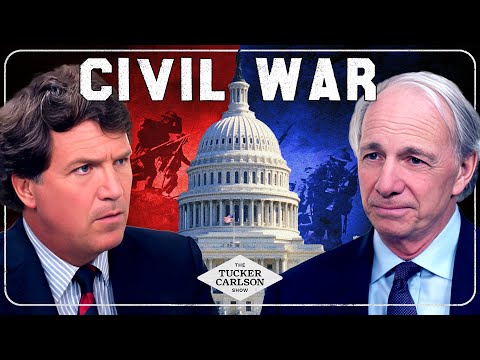
 Ray Dalio on Civil War and AI: America’s Hidden Fault Lines2026 · 43 min · full transcript
 Ray Dalio on Debt Cycles and World Order: Gold, Tariffs, AI2025 · 49 min · full transcript
 Ray Dalio on Changing World Order: How to Invest in Uncertainty2025 · 25 min · full transcript
 Ray Dalio on Principles and Decision Making: Truth, Learning, and Success2021 · 90 min · full transcript