What did Jensen Huang say about self-driving trucks and digital twins?
Jensen Huang says the shortage of truck drivers makes driverless trucks a near-term way to augment human labor, especially in hub-to-hub routes and controlled environments like ports and warehouse campuses. He then ties that to Omniverse, saying robotics and any AI that interacts with the physical world need a physically based simulator, or digital twin.
“This trend will only go up. The U.S. will be short by 100K truckers by 2023. The EU is short 150K truckers already. China is short 4 million drivers. So ideas like driverless trucks from hub-to-hub or driverless trucks inside a port or warehouse campus are excellent near-term ways to augment with automation. We started my talk with Omniverse, we'll close with Omniverse. You can see how important it is to our work, to robotics, to anyone building AIs that interact with the physical world, to have a physically based simulator, or digital twin. In the case of Isaac, the digital twin is the factory in Omniverse. In the case of DRIVE, the digital twin is the collective memories of the fleet captured in Omniverse.”
Key takeaways
- Use automation where labor shortages are already acute.
- Build robots and autonomous systems in simulation before deploying them.
- Digital twins matter most when AI must interact with the physical world.
Context
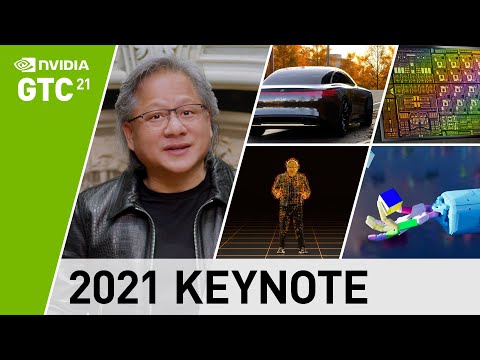
From Jensen Huang’s GTC Spring 2021 keynote, where he connected Omniverse to robotics and autonomous driving. The quote above is taken word for word from the recording's transcript.
In the transcript
…giant. We expect robotaxis to start ramping in the next couple years. These services will also be platforms for all kinds of new services to be built upon - like last mile delivery. The Internet moves electrons, trucks move atoms. The rise of e-commerce is putting intense pressure on this system - one click and a new TV shows up at your house, another click and a cheeseburger shows up.
This trend will only go up. The U.S. will be short by 100K truckers by 2023. The EU is short 150K truckers already. China is short 4 million drivers. So ideas like driverless trucks from hub-to-hub or driverless trucks inside a port or warehouse campus are excellent near-term ways to augment with automation. We started my talk with Omniverse, we'll close with Omniverse. You can see how important it is to our work, to robotics, to anyone building AIs that interact with the physical world, to have a physically based simulator, or digital twin. In the case of Isaac, the digital twin is the factory in Omniverse. In the case of DRIVE, the digital twin is the collective memories of the fleet captured in Omniverse.
The DRIVE Digital Twin is used throughout the development - it's used for HD map reconstruction, synthetic data generation so we can bootstrap training new models, new scenario simulations, hardware-in-the-loop simulations, release validation, for replaying unfamiliar scenarios experienced by a car, or a teleoperator up-linking into a car to remotely pilot. The DRIVE Digital Twin in Omniverse is a virtual world that every car in the fleet is connected to.…
Read the full transcript of GTC Spring 2021 keynote, virtual
Topics
What others said about robotics
More questions about Jensen Huang
- What did Jensen Huang say about the factory of the future?
- What did Jensen Huang say about NVIDIA’s purpose?
- Why did Jensen Huang say the time for BlueField had come?
- What did Jensen Huang say about training and serving giant AI models?
- What did Jensen Huang say about the future of robotics and AI learning?
- What did Jensen Huang say about the computers needed for physical AI?
How this answer was made: the quote is checked word for word against the transcript of the recording and confirmed as the speaker's own words; the summary above it was drafted with AI from that transcript and quality-checked. Methodology and corrections.