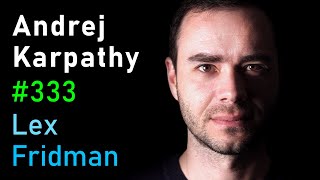
Andrej Karpathy on Tesla Autopilot
Karpathy sees Tesla Autopilot as a Software 2.0 system: vision-first autonomy built from neural networks, shaped by data curation, and improved through a hard deployment-and-retraining loop.
- Autopilot is a Software 2.0 system, with behavior learned in neural network weights instead of hand-coded rules.
- Tesla’s approach is camera-first: raw video, computer vision, and machine learning rather than lidar or HD maps.
- The bottleneck is not just models but data: finding failures, labeling them well, retraining, and redeploying.
- Karpathy’s trendline is that more of the autonomy stack gets absorbed by end-to-end learned systems over time.
- Autopilot is as much a deployment and infrastructure problem as a modeling problem because training and iteration are expensive and must not regress.

“But all in all, if you're trying to train all of the neural networks for the autopilot, it is actually a fairly expensive task. In particular, today we would train 48 different networks that make 1,000 different predictions—just if you count the number of output tensors—and it takes 70,000 GPU hours to train to compile the autopilot. It leaves the neural network stack. So if you had a single node with 8 GPUs, you would be training for a year. So it's a lot of networks and a lot of predictions, and a lot of them must work and none of them can regress ever. And then you're not just training this once—you have to iterate on this.”conference talk, 2018 · 7:23
Autopilot is learned software, not mostly hand-written software
Karpathy’s core frame is that Tesla Autopilot belongs to a new programming paradigm. Instead of writing most of the driving logic directly in traditional code, engineers train neural networks whose behavior is stored in learned parameters. That is why he describes the system as Software 2.0 rather than ordinary software.1234
This matters because it changes what engineering work looks like. Progress comes less from adding another explicit rule and more from improving the training setup, the data, and the optimization process that produces the network. In Karpathy’s telling, the important code increasingly lives in the model weights, not in a growing pile of hand-authored heuristics.24
Tesla’s bet is camera-first autonomy from raw video
Karpathy is explicit that Tesla’s Autopilot is built around computer vision and machine learning on raw video streams. He contrasts this with approaches that depend on lidar or high-definition maps, which Tesla does not use in this setup. The practical implication is that perception has to be strong enough to infer the driving scene directly from cameras.56
That choice makes Autopilot look more like a large-scale visual intelligence system than a map-following stack. It raises the bar for perception, but it also aligns with Karpathy’s broader belief that more capability should come from learned systems rather than hand-designed scaffolding.67
The real work is the data engine
One of Karpathy’s clearest points is that autonomy is not mainly about inventing a clever model once. The hard part is building a loop that finds failures, gathers the right examples, labels them accurately, and pushes improved models back into deployment. In that world, dataset construction becomes a form of programming.82
This is why he says the people shaping labels are effectively shaping system behavior. If Autopilot is learned software, then data curation determines what that software learns, where it succeeds, and where it fails. That also explains why he argues there is still little tooling that directly helps write this kind of learned code.89
Scaling Autopilot means huge training and careful iteration
Karpathy presents Autopilot as a large, multi-network system with many simultaneous predictions, not a single neat model. Training it is computationally expensive, and iteration matters because the team is continually trying to improve capability without introducing regressions. That makes autonomy an engineering systems problem as much as a machine learning problem.1011
His description of the internal goal also shows the product ambition: the team’s direction is toward ever-greater driving autonomy. But getting there requires a disciplined cycle of training, evaluation, deployment, and retraining at scale.121113
“But all in all, if you're trying to train all of the neural networks for the autopilot, it is actually a fairly expensive task. In particular, today we would train 48 different networks that make 1,000 different predictions—just if you count the number of output tensors—and it takes 70,000 GPU hours to train to compile the autopilot. It leaves the neural network stack. So if you had a single node with 8 GPUs, you would be training for a year. So it's a lot of networks and a lot of predictions, and a lot of them must work and none of them can regress ever. And then you're not just training this once—you have to iterate on this.”conference talk, 2018 · full transcript →
More of the stack gets eaten by neural nets over time
Karpathy’s long-run view is that learned systems keep absorbing pieces of the autonomy stack that used to be handled by traditional code. His framing is not that every hand-built component disappears instantly, but that the frontier moves steadily toward larger learned blocks and more end-to-end optimization.74
That is why Tesla Autopilot is important in his broader worldview. It is an early, concrete example of software becoming more autonomous through neural networks, while still needing human supervision, infrastructure, and iteration around it. In his newer framing, Autopilot stands as a flagship example of Software 2.0 before the emergence of prompt-driven Software 3.0.114

“Let's forget about all that stuff that humans have designed with all their ingenuity, and let's try to just have a single kind of blob of compute…”Conference keynote, 2019 · full transcript →
Karpathy on tesla autopilot, in his own words
“…we don't use lidar and we don't use high-definition maps…”
“Let's forget about all that stuff that humans have designed with all their ingenuity, and let's try to just have a single kind of blob of compute…”
“The North Star for the team is something we internally somewhat jokingly refer to as operation vacation…”
Where to watch
 Andrej Karpathy on PyTorch at Tesla2018 · 11 min · full transcriptBest concise technical overview of how Tesla builds Autopilot from cameras, neural nets, training infrastructure, and deployment.
 Andrej Karpathy on Software 2.0: Data Is the New Code2018 · 55 min · full transcriptBest explanation of why data collection, labeling, and failure mining are central to making Autopilot work.
 Andrej Karpathy on Software 2.0: Scaling Autonomy at Tesla2019 · 33 min · full transcriptBest big-picture framing of Autopilot as Software 2.0 and why more of the stack shifts from C++ to learned systems.
 Andrej Karpathy on AI and Robotics: Models, Agents, and Education2024 · 44 min · full transcriptBest for Karpathy’s current view of Tesla as a software and robotics company and where autonomy fits in that arc.
 Andrej Karpathy on Software 2.0 to 3.0: AI Changes Everything2024 · 121 min · full transcriptBest for understanding how Karpathy now situates Autopilot within the larger evolution from Software 2.0 to 3.0.
Questions people ask
- How expensive is it to train Andrej Karpathy's Autopilot networks at Tesla?
- How small did Andrej Karpathy think powerful AI models could become?
- What did Andrej Karpathy say about Tesla as a robotics company?
- What did Andrej Karpathy say about the first uses for humanoid robots?
- What did Andrej Karpathy say about Tesla's Dojo project?
Sources
Every quote above, word for word from the transcripts. Numbers match the text.
“…software 2.0 are basically neural networks…”
“…code—that code is not written in C++. It's written in weights of a neural network.”
“Software 1.0 is things like C++.”
“The code is now written in the weights of a neural network.”
“…we don't use lidar and we don't use high-definition maps…”
“…everything that we built for the autopilot is basically based on computer vision, machine learning, on the raw video streams…”
“Let's forget about all that stuff that humans have designed with all their ingenuity, and let's try to just have a single kind of blob of compute…”
“…the labelers are kind of the programmers…”
“…there's really nothing that helps you write the 2.0 code…”
“So if you had a single node with 8 GPUs, you would be training for a year…”
“But all in all, if you're trying to train all of the neural networks for the autopilot, it is actually a fairly expensive task. In particular, today we would train 48 different networks that make 1,000 different predictions—just if you count the number of output tensors—and it takes 70,000 GPU hours to train to compile the autopilot. It leaves the neural network stack. So if you had a single node with 8 GPUs, you would be training for a year. So it's a lot of networks and a lot of predictions, and a lot of them must work and none of them can regress ever. And then you're not just training this once—you have to iterate on this.”
“The North Star for the team is something we internally somewhat jokingly refer to as operation vacation…”
“As you'll notice here on the bottom, we have a GPU cluster. The hardware team is also working on a project we call Dojo. And a Dojo is a neural network training computer and a chip. And so we hope to do the exact same thing for training as we did for inference: improve basically the efficiency by roughly an order of magnitude at a lower cost. But I'm not ready to talk about more details in that project just yet. So in summary, I talked about the full lifecycle of developing these neural hours for the autopilot and how we own everything in-house.”
“Okay, so software 3.0 is prompts, huh? And so I—I see this as quite new, unique. It's a new kind of a computer, and, uh, so in my mind it's, uh, worth giving it a new designation of software 3.0. And basically your prompts are now programs that program the LLM. I would argue that software 3.0 is actually…”
How this guide was made: drafted with AI from the full transcripts of the recordings cited, then checked: every quotation must match a transcript word for word and be the speaker's own words, and an independent review gates accuracy. Methodology and corrections.