What did Yuval Noah Harari say is the best way to handle misinformation online?
Harari says the most effective response is not to lecture people that they are wrong. Instead, platforms should give people a range of choices and related viewpoints so they can work things out for themselves. He thinks this approach helps people feel informed without being pushed into a single opinion, and it usually keeps them away from the most extreme options.
“So what ends up working sociologically and psychologically, the thing that ends up actually being effective is giving people a range of choices. So if you show, not, "Here's the other opinion" with a judgement on the piece of content that a person is engaged with, but instead you show a series of related articles, related content, then people can work out for themselves, "Hey, here's the range of different opinions. "Or things that exist on this topic. "Maybe I lean in one direction or the other, "but I'm gonna work out for myself where I wanna be." Most people don't choose the most extreme thing. And people end up feeling like they're informed and can make a good decision. So, at the end of the day, I think that that's the architecture and the responsibility that we have is to make sure that the work that we're doing gives people more choices, that it's not a given single opinion that can dominate anyone's thinking, but where you can connect to hundreds of different friends and even if most of your friends share your religion or your political ideology, you're probably gonna have five or 10% of friends who come from a different background who have different ideas and at least that's getting in is well, so you're getting a broader range of views.”
Key takeaways
- Don't force one correction; give people a range of options.
- People are more receptive when they feel they are choosing for themselves.
- Broad exposure to related views can reduce polarization.
Context
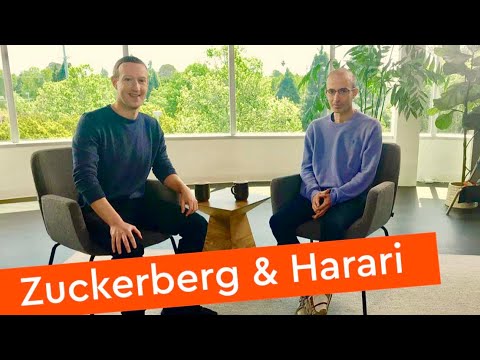
As the conversation turned to hoaxes and misinformation, Harari responded to Zuckerberg’s practical point about platform design. The quote above is taken word for word from the recording's transcript.
In the transcript
…they just end up not trusting you. So that ends up not working. If you frame two things as opposites... If you say, "Okay, you're a person who doesn't believe, and you're seeing content "about not believing in climate change. "So I'm gonna show you the other perspective. "Here's something that argues that climate change is a thing." That actually just entrenches you further because someone's trying to control and...
So what ends up working sociologically and psychologically, the thing that ends up actually being effective is giving people a range of choices. So if you show, not, "Here's the other opinion" with a judgement on the piece of content that a person is engaged with, but instead you show a series of related articles, related content, then people can work out for themselves, "Hey, here's the range of different opinions. "Or things that exist on this topic. "Maybe I lean in one direction or the other, "but I'm gonna work out for myself where I wanna be." Most people don't choose the most extreme thing. And people end up feeling like they're informed and can make a good decision. So, at the end of the day, I think that that's the architecture and the responsibility that we have is to make sure that the work that we're doing gives people more choices, that it's not a given single opinion that can dominate anyone's thinking, but where you can connect to hundreds of different friends and even if most of your friends share your religion or your political ideology, you're probably gonna have five or 10% of friends who come from a different background who have different ideas and at least that's getting in is well, so you're getting a broader range of views.
So I think these are really important questions and it's not like there's an answer that's going to fully solve it one way or another. Definitely not it. But these are the right things to talk through. We've been going for 90 minutes so we probably should wrap up. But I think we have a lot of material to cover in the next one of these that we'll hopefully get…
Read the full transcript of Conversation with Mark Zuckerberg, 2017
Topics
What others said about media & journalism
More questions about Yuval Noah Harari
- What did Yuval Noah Harari say about global cooperation and climate change?
- What did Yuval Noah Harari warn about AI and human agency?
- What did Yuval Noah Harari say about whether we can trust our inner voice in the age of algorithms?
- What did Yuval Noah Harari warn about surveillance capitalism and totalitarianism?
- What did Yuval Noah Harari say about the truth and information?
- What did Yuval Noah Harari say about truth in the age of information overload?
All Yuval Noah Harari answers · All Yuval Noah Harari recordings
How this answer was made: the quote is checked word for word against the transcript of the recording and confirmed as the speaker's own words; the summary above it was drafted with AI from that transcript and quality-checked. Methodology and corrections.