Steve Wozniak on Engineering Mindset: Building for the Rest of Us

What Wozniak talks about
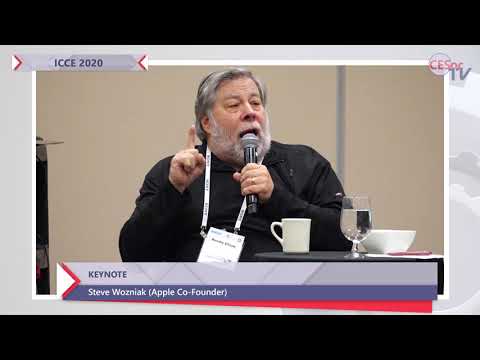
Steve Wozniak gave this keynote at ICCE in 2020, reflecting on his engineering philosophy from Hewlett-Packard to Apple and arguing that technology should be useful, affordable, ethical, and expand human choice.
Also known as: IEEE CTSocTV ICCE 2020 keynote; Steve Wozniak, Apple Co-Founder. ICCE 2020 Keynote.
Steve Wozniak uses the keynote to trace his engineering philosophy from Hewlett-Packard to Apple: build for truth, make products work, and create tools that are affordable, useful, and fun. He says he chose engineering over management because engineers stay closest to objective reality.
He revisits the Apple II, early software, the floppy disk controller, and the shift from command-line computing to the GUI, iPod, and iPhone. For Wozniak, the big story of technology is steady progress in smaller, cheaper, more capable devices that broaden access for ordinary people.
He also talks about ethics, privacy, education, and happiness. His throughline is that technology should increase human choice, and that a good life is defined less by money or status than by smiles, humor, and constructive work.
Wozniak speaks at length, with an interviewer occasionally prompting and asking follow-up questions.
In his words
“It has to be true.”
“I decided engineers were the finest people in the world.”
“I will never move up in management because it gets kind of political”
“When you develop products for yourself, they often turn out great”
“Happiness equals smiles minus frowns.”
Key points
- Engineering, for Wozniak, is about objective truth: products either work or they don’t.
- He preferred staying an engineer over moving into management or politics.
- The Apple II mattered because it made color computing and software-driven games affordable for the masses.
- He emphasizes designing products for yourself and giving engineers access to schematics and code.
- He credits milestones like the GUI, iPod, iPhone, and the internet with making technology easier and more human-centered.
- He sees ethics in technology as a human issue: more choice means more freedom.
- His personal life formula is happiness through smiles, humor, honesty, and constructive thinking.
Full transcript: Steve Wozniak, ICCE 2020 keynote
(music) When you work out your equations or your program, it is following a set of steps, and it has to be done correctly. It has to be true. It's not like I can use better words than you and get judged subjectively on my words. Objective decisions. When you develop a product, it has to work or not work. That is an element of truth. I decided engineers were the finest people in the world. In my mind, when up before Apple, I
was working at Hewlett Packard. Back then, Hewlett Packard only made test equipment with dials and knobs and voltages, things that engineers used. And, since I was helping design these products, the handheld scientific calculators, I was an engineer designing products that engineers used, and we engineers at Hewlett Packard were partly marketing because we knew what was good or bad in engineering equipment. And I decided, I am gonna be, I'm an engineer's engineer, but I am going to be an engineer for the rest of my life. I will never move up in management because it gets kind of political where you take sides and you don't necessarily be truthful about things. Work like an engineer has
to. I'll be an engineer for life. And I told everyone that I will be an engineer at Hewlett Packard for the rest of my life, and it was the hardest decision to form Apple. So, being recognized for engineering when I developed the Apple 2 computer, this is the product. The only money-making product at Apple had for the first 10 years of the company was the only successful product: this computer. It was so far ahead of its time, it brought the world from black and white to color in a computer, in a low-cost computer. But more than that, I was interested in fun and humor in my life, games. I had developed games digitally for myself and for Atari, a typical arcade game. Atari
was forming a new industry called arcade games. Atari in Los Gatos, California, where I live now, and their games were typically a hundred and fifty chips, thousand wires that an engineer like myself had to hook up to make sure all the signals were going up and down on the wires at the right time to show up as paddles and balls and a game on a TV set. But the Apple II computer that I developed was the first time ever that arcade games for the masses became colored. We moved from black and white to color. All the Atari arcade games in bowling alleys and the like were black-and-white TVs
because color was very expensive and hard to do. But, more than that, the Apple II computer that we called a computer, but it was really an incredible game machine, arcade machine, was the first time ever that our arcade games were software. You're not the first time ever if you have a lot of money in a research project, but for the masses, for a real product, first time ever arcade games were software. A nine-year-old could sit down with a simple programming language, BASIC, and write a game with moving pieces on a screen, a decent game, in one day rather than an engineer hooking up a thousand wires over six months to get things right. This was a huge step forward. So, I didn't do it, but did I do
this stuff to start a company? No, I never thought about it. I didn't want money. I didn't want to ever be super wealthy or anything. Didn't really want that, and I didn't want the politics of running a company, managing one. I turned down the big money for Apple at first because I didn't want to run a company, and I only accepted it once it was clear I could be an engineer and nothing more. And so, here we were. So what I wanted was not... I did want to bring in my great computer to the world, but I built it for myself. It was the product I wanted, just like Elon Musk wanted a large electric car for his large family. He wanted supercharger stations so he
could drive from his home in Southern California to the factory in Northern California. When you develop products for yourself, they often turn out great, and even Jobs in the iPhone as an example. But I wanted this for myself, and I wanted what I wanted. When we started, Apple started getting noticed and publicized my Apple II computer. Everything was open source, and the schematics and then the circuits were published because I wanted people to see my work. I wanted other engineers to see it. I wanted engineers to come up and say, "Wow, how did you come up with these things that are so different?" Than in a book, for example, in a book we had learned in analog and electrical engineering
how to design with op-amps and feedback circuits, differential calculus, how to design. I was an analog engineer, how to design color into a TV, how to mix the red, blue, and green components and take all that into account. It was a long, long, difficult, expensive process. Maybe it cost five thousand dollars to put color on your TV. And I figured out for some reason a weird idea pops in my head or whatever. This was kind of how I worked. I accepted weird ideas that if you took a number in a computer, the ones and zeros—the number 60010110—put it on the wire into the TV at the right speed, every
television in existence would think it was color. Never in a book, never in an engineering book, not even valid, not legal, not the way mathematics design color television. But it worked. It was just something that nobody else really saw. And so, sorry, I wanted people to look at my designs and say, "Whoa, where did he come up with those ideas?" I was like in a ten-year period of magic coming out of me. And I also wanted them to look at my code and say, "Oh my gosh, how do you do that?" The code of this product, which was Apple Computer, all of its revenues for the first ten years of the company—this was our only successful product making money—the Apple II computer, all of the code
Filled a binder about two inches thick. I had no money. I had no bank accounts. I could not afford a timeshare system where you sat down on a terminal and typed in a program and it calculated the ones and zeros to go in your computer to run that program. I couldn't afford it, so I wrote my program on the right side of a sheet of paper, and then I used little cards to figure out what the ones and zeros would be, and what the references and addresses and things would be. And I wrote all the ones and zeros in hexadecimal on the left side of the pages, two inches thick in a binder. And then I typed those numbers in, exodus 12, 40 minutes in a row. I could type in, you know, 4K worth, 4 Kbytes, almost BASIC.
Language, and a lot more. This was, who ever heard of that? So, what was your throughput, you think? Anyway, my throughput, yeah, your how many pages per— I don't know. When you're doing it yourself, you're all motivated. You're so motivated, which I was. I had to have this. A lot of that software was BASIC writing a language, BASIC. I've never even programmed in BASIC. This is the way a good engineer should think. You don't have to know it already from a course at the university. You don't have to know it from a book. You just have to know how to create things and write your own book and do it very, very proficiently. So I knew that BASIC was the language we needed. I had only programmed in the scientific languages of the day, Fortran.
Algol, PL/I. BASIC was a kid's language, but I could sniff the air. If people were gonna buy computers in the home, they were gonna want a computer in the home. It had to play games. And there was a book out, 101 Games in BASIC. So I went into Hewlett-Packard late at night and opened up the BASIC manual, and I started writing notes as to what the language was. And then I figured out, how do you write a language, an interpreter, just from scratch? And the best things I ever did happen for two reasons. A, I had no money and had to make it affordable. And B, because I'd sit down never having done these things, never having worked with a microprocessor before, never with dynamic memory, never
never with BASIC, never with any disk drive hardware or software. Did the floppy disk in two weeks, just so I could get to Las Vegas for the Consumer Electronics Show. They were gonna let Apple in. We were only gonna send three people from Apple, right, marketing guys, you know, and I'm too shy to raise my hand and say, "Well gosh, I'm a founder of the company. Don't I get to go to Las Vegas? I want to see the lights of Las Vegas." And I said, "I don't know why I did this," I stuck my hand up in the staff meeting. There were five of us that really ran the company the first couple years, and we were one year in. We didn't have Bob. Bob's VisiCalc yet. There's a spreadsheet that was gonna make the whole market successful, but we needed a disk.
So you could say, run VisiCalc rather than have to pull cassette tape out, and that says VisiCalc on it, read it in with a cassette tape player. A huge difference going to a disk. So I raised my hand in the staff meeting, and I said, "If we have a floppy disk, can we show it?" And Mike Markkula, who ran the company, he was the adult, the top Steve and I: How you set up a technology company, said yes. And my wheels are spinning. If I can develop a floppy disk controller and the software where you can type run a program and it runs, if I can do that in two weeks, I get to go to Las Vegas. They'll have to take me. They won't have a choice. And that was—I worked every day, Christmas, New Year's, man, turned out this incredible design. But I didn't know how floppy disk
drives were done, how any disk material was done. I just sort of knew when writing on mandana magnetic. I analyzed some schematics. I got down there and built mine up, and it was just eight little $1.00 chips, you know, and I just—I don't know—those, like I said, magic can happen when you're an engineer. And it wasn't just a conventional floppy drive. It wasn't that a variable-speed floppy to maximize the density. Oh, that was later on. That was later. That was later on. Okay, yeah. But it was pretty interesting. It was just a whole different mixture of you don't put everything necessarily on a floppy disk controller. You share some software of the host computer. You don't just write to it through a serial cable and let it figure out what to do with files and all that. And that allowed us to write software on our host computer, the Apple
II computer, to increase the density and increase the speed, increase the capacity of our floppy disks. I mean, it was just like almost unheard of stuff. And it also allowed things to be done so optimally with the very, very few aslope cost parts by sharing the right amounts of the tasks with software. Anyway, anyway, I'm just proud of the engineering. I wanted other engineers to always come up to me, and they did. And they did, especially once understood what, how it changed the world at that time. Our first logo at Apple was six colors, and our name was not Apple. It was Apple Computer. We were—it was a little different than today's Apple. Today's Apple understands people lifestyle needs were very flexible and moving around as to what they are and
Steve Jobs never understood computers, hardware or software, so of course he was successful with the iPod. He understood people, so that was the great thing that happened to us. As far as computers go, Steve Jobs is distant from computers, aided the world a lot. In the end, he failed with the products he tried to build that were computers, but he had this vision. One time he never used a computer in high school—same high school I went to—but four years later, they had a terminal where you could connect over time sharing and type in BASIC programs. A terminal was a printer and a keyboard, and the computers were way out there somewhere. And he had this vision when the internet came that
everything, even programs, were gonna—software was gonna be out there. And that's the way it went because bandwidth increased on landlines. Bandwidth increased, cellular came, cellular bandwidth. So that's really the way that got us to where we are today with our small handheld products that do all the internet stuff. You know, what I was just thinking about is, in Silicon Valley, you know, in the Santa Clara Valley where you were, about the time you were doing the Apple One, there was actually the Homebrew Computer Club, for example. There was kind of like—and it's like anybody who wants to create an innovative environment. It's kind of like, I think, was an inspiration to a lot of people, including you. Yeah. Well, the app—yeah, we had a Homebrew Computer Club, and it was a whole bunch of geeks, pure out now. Geeks that somehow
had this idea that if we could afford our own computers, we could do more than ever. We could communicate better, social benefits, we could educate better. The geek would be important at work where he could write his own programs, he or she. And this club of about 200 people—the big computer company said no, no, no, never gonna be any money. This thing's not going to go very far, and they weren't into it. Hewlett-Packard turned me down five times. I wanted them to build the personal computer, but they just didn't see it as a business at that time. So the Vice President signed it off; every Hewlett-Packard division signed it off, and Steve Jobs and I had to go into business, and I started to say. So I was
just asking about, you know, creating an environment that inspires people that do stuff. Well, inspire stuff. Well, I always wanted to be a teacher and inspire others and make life fun, and that's a real key to learning. So that's a different aspirational question. My voice is holding out. I could still whisper if I have to move it. What do you think of the most in interview—some of the most important moments in the history of technology, moments in the history of technology? Web technology is a vague term. It is what? If you said a hammer, a wheel, you could go through thousands and thousands, you know, a nail. But I think we're talking kind of towards electronics technology and some of the very, very important things. I mean, obviously airplanes and cars are
important to be, electronic or not, but go back to radio. And every when I'm in Florence, Italy, I go to this one church and they're right next to Galileo's tomb is Marconi's—Marconi of radio. And I grew up with a ham radio license at ten years old, and so important to me protecting the waves and the mathematics behind it. So radio was a big thing because it led to radio was a technology that led to radios that we use and we hear music on any time. Television obviously is another follow-on. Moving to color television was a huge technology step. Other people that are interested in different things might say radar was a
huge technology step. In my very, very youngest days, computers have long history of many steps, and in recent times, I'd say computers were getting smaller and smaller. Moore's law—where does Moore's law come from? The transistor. Okay, Gordon Moore. I'm sorry, Gordon Moore. William Shockley, Bloom Shockley was one of the inventors of the transistor and moved from the East Coast to Mountain View, California, Silicon Valley, to start a company to build an expensive transistor that would revolutionize phone companies all over the world. And he hired a lot of
engineers, and they learned the technology and work with one transistor. All they could make on a chip: one transistor. And they didn't succeed, so a lot of the engineers left. They formed a company called Fairchild to build a simpler type of transistor—the normal type—and it was very successful. But then they figured out how to make chips, and the huge step that made chips: this was another step because my life started with vacuum tubes, then I saw transistors, and I built projects in elementary school science fair projects with hundreds of transistors, never lose tic-tac-toe, add and subtract digital numbers, and then came transistors, but then came the first chips. Chip might have like a little six transistors on
it, one little gate, logic gate, very simple at first. But what made chips work, there were two Nobel Prizes—I'm sorry, not Nobel Prizes—two Nobel prizes for inventing the chip. One was a design out in Texas. What? Kill you? Oh, yeah. Jack Kilby. Got killed by Jack Kilby. Yeah, I'm Anna Manning. He was a true engineer, and this was kind of an analog device. But out in Silicon Valley, Gordon Moore and Bob Noyce came up with this technique, and really a guy you never heard of: Jean Ernie deserves a lot.
Of the credit for the planar method, the method of taking photographs and etching photoresist and putting etching step-by-step and implanting impurities in the silicon or germanium to make more than one transistor on a chip. When I was about seven to nine years old, that young, I went to a show in San Francisco called Westcon, and at that show, a man held up a little design that looked like a bunch of buildings and roads. And the early chips, though, were so expensive you couldn't afford them. They weren't 25 cents; only the military could get them. There was a space race. The Russians had launched the first man into space and into orbit, and we had to catch up somehow. And then we had to get to the
moon, and in those days, every little gram that you added to the weight that you were lifting with a rocket was incredibly expensive. So to save weight, you could have six transistors on one chip and save weight. And that was really one of the impetus. There was a company in Silicon Valley, Lockheed Martin in Sunnyvale, that would buy a lot of the early chips and allow this industry to be accelerated in how it progressed. Okay, so these were—those were all steps. Now, personal computers came along. I mean, there were a lot of steps; I'm skipping no doubt, but personal computers came along, and it was computers could be owned by a person. That was a big step too, actually.
Eventually from there, of course, we expanded memory, and eventually disks—disks like hard disks came to human-being pricing. You can store an awful lot in your little machine now. When we started Apple, the amount of memory, RAM memory, that would hold one song cost the better part of a million dollars. Did we foresee the day that you'd have a thousand songs on an iPod? You know, you don't know how far Moore's Law is gonna go before it stops, before it hits a limit. You just don't know these things. So it's all guesswork, but obviously we got to the point that we could now have music
on devices. Now, I've skipped a lot of things like hi-fis and all that that were involved with music and different types of speaker technology and whatever. They were very important, but directly in my life, we got up to the iPod. Oh, before the iPod though, our computers were command-line computers. You would memorize what to type to get things done, and along came Xerox PARC. Then Apple decided to build a Lisa computer based on mouse-based technology, the GUI—the graphic user interface—the windows that would open and menus that you could click buttons to bring up from familiar words how to do things. And our philosophy at Apple was "Make things
easier than they ever were for somebody who's never been around computers who is not a computer expert. Make it for the rest of us and just have little suggestions." If an icon looks like a paintbrush, what does it do? It paints. So we came up with the Lisa computer, and that was a big step, the mouse-based computer. The Macintosh eventually came. It was a horrible financial disaster for Apple. There was no software for it yet. No businesses would buy it, and that's where the market was. And we had to take three years to work on getting software and developing a market for the Macintosh. Its sales were like 500 units a month. Our stock dropped almost in half in a week. You're in a big company and your stock
drops almost half in a week, it's like scary stuff. But the Macintosh was still the future, and we believed in it. I believed in it. Our CEO John Sculley believed it was the future. It's just the steps to get to the future. We're different than Steve Jobs, who wanted it for a different purpose, which was to make himself known as the most important person in the world. He always wanted to be one of those important people. He had the vision, but he didn't really have the operational skills to realize what was needed to make the Macintosh enough of a product to pay for itself. Okay, that was a step. Now we get to the iPod, and there were a lot of people trying to build little MP3 machines in those days. You could buy
MP3 software for your Macintosh or for your DOS machine or your Windows machine. You could buy these little MP3 players and play songs. I love things smaller, smaller, less money, smaller footprint, and all that. Look, the small ones all over the world—I like to go to Japan to see the new products coming up—and I found a little one from a United States company, the Diamond Rio, the Rio 500. You could take a little smart card made for taking pictures on phones, and it could only hold two to four songs, two to four songs per card, and you could plug them into this machine. Now you'd have two to four songs, unplug it, plug another two to four songs to get enough songs to go across the
country on an airplane. Cost about $1,000. Okay, but it was possible to do it with pure electronics, not a moving disc. Well, the iPod came out and actually used a new little one-inch disc—in one, one inch, one inch, one 1.7—but one disc, and that could hold the thousand songs. What a beautiful device that was. I played with mini disc recorders. All the music devices there were were a part of my life. And when the iPod came out, I don't judge things just because it's from Apple. It's got to be good; I try it. I use it. I get personal experience. Every bit of technology to this day, I like to buy things even other brands than Apple, Leaf, and other phones, and try them, and use them, get to know what other people
Are doing that. iPod just took me over in just like an hour of use in it. This was my music machine for life, and then came the iPhone. And who could ever imagine a phone without the buttons, just a screen? Technically, from an engineering viewpoint, it's actually economical when you don't have to build extra mechanical devices, and it's pure electronic, getting away from mechanics. That's what I liked about the music players that have little cards, and you know, which is what we go by today, little cards of damn flash memory. So the steps, I don't know, we got up to the iPhone. Obviously, we've made it. Things got small. Oh, the internet came. I forgot cellular phone. Next to cellular phones came the internet came cellular.
Phones found a way to get data. Bandwidth came, and then everybody, then the internet came, and everyone was dialing up to get on the Internet. Man, I loved it because where I lived you could never get a phone number. I was interested in repeating digit phone numbers. You could never get a phone number, a seven-digit United States phone number in the 408 area code. That was all 72, just the same: 2, 2, 2, 2, 2, 2, 3, 3, 3, 3, 3, 3, 3. And I wanted these. I have lots of ones with six digits the same. I was collecting numbers. But you couldn't get them because area code 408, San Jose, way down to Monterey area code 415, Los Altos up through San Francisco—they didn't share any phone numbers between
those two area codes. But the internet came, everybody started getting extra phone lines in their home to be on the internet, and they ran out of numbers. They started sharing them. So eventually I was able to get the number of my life: 888 today. And I found that I couldn't use it. 100 babies a day were pushing 8 a day, day, day. They day and they were babies that could not talk. They could not talk or listen to what you said. People, mama, mama, mama. You couldn't get to a mother, but 100 calls a day, and that's all it was. So I couldn't really use that phone number for a long time until we got 10-digit dialing in the air for weight area code,
or I eventually found a little service on the internet that says press one for Steve, press two for Janet. The babies can't do that. I had another phone number that was interesting: 2 3 4 5 6 7 8. Engineers like to do these sort of things, you know, just no reason. There's no money, there's no business: 2 3 4 5 6 7 8. And I got a lot of calls every day, dozens of calls every day. They were from slightly older infants that could barely talk. They could say their name. They were learning to count. So cute. Yeah. So let's see and other. Yeah. I had one number: 2 2 1 1 1 1 1. Remember the old rotary dial phones? Any
of you? The shortest distance, the number that was the quickest to dial was one. The next was two. There's only—it was only one legal assignable number in the United States 70. Did your phone number that had two twos and the rest ones: two 2 1 1 1 1 1. No other way. That was the shortest. And I got it in my area code. And then I had a lot of calls every day on that phone, and somebody hanging up. I carried, you know, paper flight guides. I like to be very self-sufficient when I can. And I was, I would turn my flight guides. I've booked my own flights. I call the airlines, and Pan Am had 802 211111 numbers. Catch my attention always. So,
I said, "Maybe some of those calls are from Pan Am." Next time the phone rang, I heard someone hanging up and I said, "You calling Pan Am?" And she said, "Yeah." I said, "Oh, we were on our lunch break. What can I do for you?" Being able to think on the fly and ad-lib these little jokes for wrong numbers, I mean, I wound up. So I put my first phony flight that day, and then over the next couple weeks, I just started going further and further. I said, "Well, if you want to cut your fare, you go through our grasshopper special. You fly up to Billings, Montana, down to Amarillo, Texas, up to Moscow, Idaho." They don't even have airports in some of these places, I'm sure. But I said, "It cuts your fare to go through our lesser-used airports," and they would believe me. They thought they called Pan Am; they believed me.
I answered every call for the next two years. Pan Am international desk, Greg speaking. My friends would say, "Steve, Steve, it's me." Do you think that's why they went back? Right? No. No. I would have gotten caught. Somebody would have realized what number they called. I would get caught by the police and arrested. So at the end of booking the phoniest flights I could think of, I would tell them, "You fly to, you take our gamblers special." "What's that?" "You fly to Las Vegas, and then you roll the dice. And if you get a seven, the next leg is free." They would be able to leave it. So anyway, I had a lot of fun with those numbers, but at the end of the call, I would say, "I'm a prank, it's prankster, this is a prank, I'm not really paying out. Good, good," you know, so that so I wouldn't get arrested somehow. I just always stayed on the safe side of the
fence, barely. I don't know where we were, what we were in, a number of places, sounds like. But I had a question for you, you know. So you got a bunch of engineers and technologists in the room here. When you were doing the Apple I or any of the creative stuff you did, what was your state of mind, and what would you recommend for people to get yourself ready to do something creative like what you did? Okay, let's go back to two products: the Apple I and the Apple II. I did all the hardware, all the software myself. And the output one was not a computer design. It was not a Wozniak computer. I had a terminal. I had seen somebody on this thing called the ARPANET. The ARPANET stretched out to five or six computers: MIT, Stanford Research Institute, UCLA, UC Santa Barbara.
University of Utah, and I saw them on it. And so, oh my gosh, I went home. I found a keyboard I could buy for $60, uppercase only, and I could run wires into my TV set already for Pong games and all that and get data on the TV. And I designed this little thing that I would type to a computer in Boston, and it would type back to my TV in California. That was my television terminal. I didn't have any purpose, Ward, no business. Steve Jobs has come to town about once a year. He did turn that one into money like all of them, because he had zero money, and I had this terminal. And we had the Homebrew Computer Club, and the microprocessor chip, I saw a spec sheet on it, I said, "Oh my gosh, these are like those little computers." I taught myself to design processors. I taught myself to
design in high school. Oh my God, my formula for owning my own computer that I told my dad I someday would own a computer. And he said it costs as much as a house. I said, "I'll live in an apartment, come on now." I saw my formula. What is that? The MOS, the first unit, the MOS microprocessor. Well, anyway, I couldn't afford the Intel $400 microprocessor single quantity and I wanted to design my own computer. There were little kids called Altair; that were the Intel datasheet turned into hard parts, but they were like a computer. I'd built five years before, switches and lights for ones and zeros, button to get into memory. I'd read, no, that computer, I'd been there the week that I met Steve Jobs even, and I wanted something human you could type in a program and get answers
solve problems. And that needed at least four K of memory, meant you had to use dynamic memory to do it right. All these, those startups were trying to use static memory in, but the Apple One, I just took my terminal and I added a microprocessor and dynamic memory. And to get it refreshed, you have to keep giving sequential addresses tugged in dynamic memory to keep it refreshed. Short forgets everything. But I already had counters counting horizontal vertical on the TV. I just grabbed one of those counts every so often and popped it in the RAM, and that took care of it. Okay, so I, so I had modified an existing terminal designed for the lowest price, the smallest parts to work over slow telephone lines that
wasn't really designed as a computer from the ground up. But I went to the Homebrew Computer Club, and these were people that wanted to revolutionize the world. We used the word revolution. We wanted to bring computers to people, and I passed out my designs for free, no copyright notices, nothing. I just gave it away, said, "Here, for $300 you can build a useful computer with enough memory to have a programming language." And then Steve Jobs came into town, and it's not like that movie with Ashton Kutcher where he finds me in a basement working on a computer and hauls me down to a club. I've been the club every day since it started. I was a hero at the club showing off my computers. Steve, and Steve had never gone. He didn't. I took him to the club to show him what it was about.
And that was the Apple One. But before, and we, and, you know, going into business, I would not risk my job at Hewlett-Packard as an engineer. So I proposed it to them, and after enough turndowns, we were in business. And we had no money, and a local store wanted to buy $50,000 worth. Uh, this Steve work managed. We got the parts on 30 days credit, built the computers up in ten days, no lawyers and bureaucracy of management. And then we drove it down to the local store and got paid cash. So that was, that was how we organized the company at the Apple One. But before we ever delivered an Apple One, let me tell you another thing I cared about, education, young people, their upbringing. This is what's gonna
give you status in life. It's gonna give you a home, a family someday. It's very educational. For two hours up to Cotati, California, to see a woman who hauled a mini-computer into elementary schools like where I had discovered this digital technology where nobody could. And she showed them how computers worked and talked about how they were programs written by humans. And, aha, two hours driving back home, I tried to talk Steve Jobs into giving Liza Lowey the first Apple One computer, and he wouldn't do it. He made me buy it for $300 and give it to her. And I did the very first Apple One. She still has it. But I believe that. But before we ever
shipped this Apple One computer, I was showing off my Apple II computer. It's a color machine, the arcade machine, incredible shrinkage of parts and an increase in performance. This was a machine so expandable, expandable, lots of slots you could plug new ideas into, new hardware for different things you came up with, you know, sensors for equipment, floppy disk drives, other things. You could plug more memory into it. It was so expandable, and everybody else thought, I know, you just want to make the absolute cheapest, cheapest, cheapest thing you can. Commodore and Radio Shack kind of jumped in the market, of course. Commodore, before they jumped in, they came to the garage. Chuck Peddle came to the garage. I demonstrated all the Apple II, what it would do. I had typed in a few commands,
and drew color swirls on the screen and little after-dark type displays. It was an impressive demonstration. I even got to show it to Intel staff one day long before we had the Apple II out as a product. And Chuck Peddle looked and said, he went back to Commodore. He wanted to do his own thing. He wanted to be in charge of his own product, went to Commodore and said, "No, no, people just want a chiclet keyboard, name one little black and white screen, very minimal; they don't want graphics; I wanted all this neat stuff. They want expandability. They don't want to add, you buy it with 4K RAM, and you don't want two slots to add more 'cause slots cost money." And he was kind of wrong because the head of engineering, Commodore, eventually came to Apple. I said, "We have the right product anyway." So
The Apple II. We had two starts of Apple. The state of mind was, I wanted my own computer, and I had a formula, and I was ahead of almost anyone in the world for affordability and usefulness, and I just want to show it off. And that's what I've done with all my little technology projects in my life that weren't worth money. The Apple II, though, was a strange one. I didn't give it away for free at the Homebrew Computer Club. This one, even my engineer friends, Aguila Packard, said, "This is going to be a great product." And I loved the games. I had designed Breakout for Atari, where you hit the ball against the bricks. It's a black and white game back then in the arcades, and I wrote it in one day, actually 30 minutes. I wrote it in color in BASIC on
my own computer called Steve Jobs over on Shaky, and I was shaking, and so is he, I think. Over, you could just change some number, the one little number, and the color of the bricks would change. Was that simple? Tiny little programmer I wrote. I did write, um, being an engineer, I did write a version of my Breakout game was in color on the Apple II computer. I did write a version. If you hit Control Z, it went into a mode where the path, the paddle, jiggled and jiggled but never missed the ball, so that somebody would think they were playing and never lost. I took it down to the Homebrew Computer Club and let one person play it who'd never really played these video games, and he won the game. He
didn't realize it was playing itself, but anyway, my state of mind was, it's a lot, this is a lot of fun in the world and it's neat to show off, and it's useful for games, but I have my own little, you know, puzzle comes up, I want to write my own program to solve it. At work, Hewlett-Packard, we had one big mini computer shared by all the engineers. Now I had my own little computer on my desk, and I could run my own simulations of my logic designs for chips. I could run my own simulations on my own computer without waiting. I mean, so it was actually my work machine as well as my fun. So it was kind of, you built something you wanted to have. Oh, totally. You know, this is exactly built it for
myself, what I want to have. Secondarily, I want to show it off and impress people about my engineering abilities. OK, so there's a lot of technology things going on now, and I understand you have some concerns about some of the things that are happening, maybe it's where AI is going to go. Can you talk a little bit about generations of technology? I read an article just a couple days ago, and I mentioned how the Gutenberg press, the press was changing the world. Kind of thankful for Apple B in that way, a bit to privacy and human rights. You've heard of the EFF, Electronic Frontier Foundation? I was one of the founders and on the first board of that company. I only left
the board once we got, what do you call those guys in Washington that sit down with politicians? Obvious lobbyists. Once we got a lobbyist, well, that's politics, and I was gonna be engineering my whole life, not law, not politics. So that's when I left the board. But, you know, okay, but that was just important. I still have a lot of my opinions. I'm not political, but a lot of my opinions go towards, you know, human rights. The human should always be more important than that, even governments. The guy with nothing should be as important as the guy with wealth and power, and I'm always, you know, trying to fight those rights. Sure. Sure. Are there particular things that you're worried about in terms of where technology can go or, you know, kind of the ethics of things we do as engineers? Well, ethics is honesty and
well, a lot of it disappears, but not in technology. The technology is pure. It's the people behind it. They get control of it, the use of it, that use it to, you know, basically not give us as much choice. To me, anything you happen, like choice equals money. For example, let's say you're gonna hire somebody, but they live too far away, and it's gonna be a long drive for them. Oh, well, just pay you enough to have a limousine take you or a bus, and you can do your work on the way. And there are solutions you can come up with. The more choices you have, the more you— that's really freedom in life. Okay, and a lot of our choices really disappear, and we don't even notice it all that much, but, um, you know, if somebody's just being dishonest with me,
all my life, I had a formula that life is not about success. It's not about how much money you make. It's not about starting companies. It's about how you feel, smiling versus frowning. So I came up with a formula. Oh yeah, in those personality-forming days so it would stick with me forever, that life was about happiness. It was after I read an article in some magazine about Sumner Redstone and Viacom and trading 50 million dollar companies and all this big-time stuff, and I said, you know, I just want to be an average, normal person in the middle having a lot of fun. So my formula was H equals S minus F.
Happiness equals smiles minus frowns. Like jokes and pranks, being creative, reading anything, a program really brings a lot of smiles. How do you avoid frowns? One thing is just be constructive. My car gets dented, don't look to blame others. Don't be judgmental. Don't look for a cause, a problem to be sad about, to say, "Hey, a car got dented, cars get dented," and let's be constructive and go get it fixed. And also I learned, you don't argue with people. Don't argue. You've got a line of thinking, is it connects to me, connects to see, connects to these, see this, and if somebody doesn't agree, you walk away, and you're frowning. So don't feel I have to win things. I don't have to take sides.
Don't be. It's a non-conflict mode of thinking that I have. So, happiness equals smiles - friends stop the things that give you frowns. But I came up with a slightly varied variation of that formula in later years: H equals F cubed. Happiness equals food, which is the metaphor for the necessities of life to be happy - food, fun, and friends. Three things, three elements. And I was being inducted into my high school Hall of Fame; the students started laughing when I said that. I had to be real embarrassingly; I had to go on the microphone and say, "Well, there might be a
fourth F anyway." Sense of humor and honesty are the two keys. Yeah, I applied to technology as well as my life. Felt very good. So, what kind of things do you think of doing in 2020? Uh, what's this year having store fee? Or the next decade even new, you know. Well, a long time. I remember when I was flying and I thought my life was starting to get real busy because of Apple. I thought if you don't have enough time, hundreds of hours to up your rating to twin-engine and instrument and jets and all that, then you know it's not worth just flying your friends off to have lunch once in a while. When I'm 50 years old and I have all the time in the world, it doesn't happen that way in life.
So, I've always been, I guess, very work-minded and I worked hard. I taught; I taught for eight years of my life, two elementary schools in the public schools. No press allowed near students. I wouldn't allow it, and I taught how to use the computer for everything in school, 200 hours per year. These students, these young students, 11-year-olds, they earned their computer. And then I started teaching 7th to 9th graders. I got up to seven days a week of classes. It was that important in my life. You work on it a lot, and when I get through things, I don't want to go back there, don't need to go back there. It was exciting for kids to own a computer back
then; that, of course, was good. Well, now I have education and technology. I've been part, big parts of my life. And you might have heard of Woz U, a technical online university, largely online but partly in facilities all across the nation. It's expanding across the world now. That's run out of Phoenix. So, I'm involved in a business that way. I also, and III, I gave away all my money to museums and things like that because I really didn't want that sort of wealth, you know. Having a street named after me in San Jose is worth more and a lot of great museums that I helped start. So, I got there, and then I did this education. You're given a lot of computers to schools, and I said, if you have a ton of
money, giving it away, that's just nickels and dimes. It doesn't say it's a sacrifice in your heart. But I'd always wanted to be a teacher. That's why I did my teaching for eight years of my life. Incredible and incredible amount of my time. Right now, I've got Huazhi, which is education and technology. I'm involved in a couple of blockchain efforts. I don't want to start a new digital currency. Bitcoin is gold. It's pretty amazing how to now could be decentralized and lasts as long as it is and not have bugs and problems and all that. But if you have a company that's earning a lot of money, a lot of revenue already, then using a blockchain as another method of finance, and it is just like stock, that's
blockchain. A token, a blockchain token, can be like stock in a company that has a good value and it's not lost. So, I'm involved in a couple of those, a couple of stock exchanges that are opening up to blockchain tokens on their stock exchange; ones in Gibraltar, ones in Malta, and I, and I... Oh, I've also been involved in putting on Silicon Valley Comic-Con. Oh, that's right. Yeah, he likes you, Miss Stanley a bit. Yeah, but I've been speaking an awful lot. Public speaking became a big part of my life. You know, a friend of mine, a well-known hacker named Kevin Mitnick, was phoning me like at 2:00 in the morning, and he's in Moscow. Ain't phoned me, I'm in Prague.
I'm complete. Phone me, he's in Bogota. I said, I'm kind of jealous you're getting all over the world. I haven't used a passport in ten years. Reasons for this, reasons for that. I just sick and tired of travel. I said this kind of interesting is going all these places. He says, "Oh, I give speeches. I'll introduce you to my speech agent." And so, I met her, and I said, "Okay, book me. Speech is fine." I started speaking publicly, and it got up to where I was doing a hundred a year, mostly foreign, and got up to, you know, even very high paying for it. So, I'm constantly travelling, 200 airplane flights a year, and now I'm trying to cut way back because of family. Right? My family is four little dogs mainly I have to worry about. They don't understand why daddy goes, so the
speaking is kind of curtailing down. But starting some of these businesses will maybe click in, will see, a believer, or you still won't have. Had some in equation if you are, have, a same age as me, you, you, and you also use an iPod. The Macintosh is a quite an amazing machine, as I am. The fellow committee members to review the application of Steve: I'm very surprised why he did not apply before. So, for the auto committee member agree, and Steve would be the best one in our society. So, finally, he
Can get the diesel a war. Yeah, congratulations. Yes, we got home from a cruise the other night. I don't know, we had one hour at home before we had to drive and leave to Las Vegas through the night. And before I'm going, I noticed in the mail I had my fellowship, my fellowship document and pin. I forgot to bring them. (applause) (music)
From YouTube captions, lightly punctuated for readability. Timestamps link to the video above. Errors are possible.
Cite this recording
Steve Wozniak, “ICCE 2020 keynote”, 2020. Transcript and video: Thinkers Archive, https://thinkersarchive.com/steve-wozniak/engineering-mindset-icce-2020-keynote/
Quoting a passage? Link to its exact moment: every timestamp above has its own anchor (for example https://thinkersarchive.com/steve-wozniak/engineering-mindset-icce-2020-keynote/#t-132).